
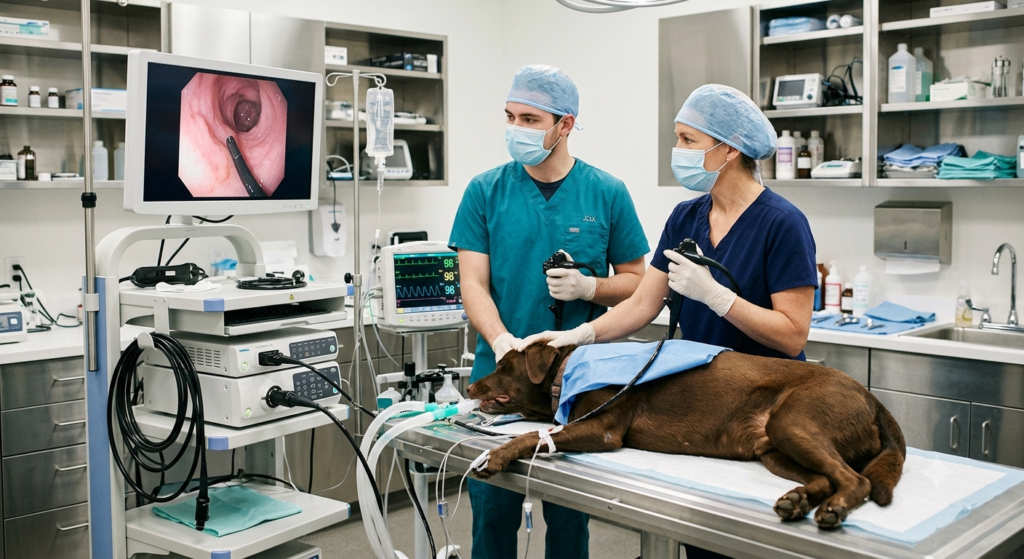
If your dog swallowed a sock, or your cat has been vomiting for weeks with no clear cause, your veterinarian may recommend endoscopy before ever mentioning surgery. It is one of the more misunderstood tools in modern veterinary medicine, mostly because most pet owners have never seen one used. At Dixie Animal Hospital, we perform on-site veterinary endoscopy for Mississauga pets, and this guide breaks down exactly what the procedure involves, when it is the right choice, and what to expect before, during, and after.
What Is Veterinary Endoscopy?
Veterinary endoscopy uses a thin, flexible tube fitted with a camera and light source, called an endoscope, to look inside a pet’s body without a large surgical incision. The scope is guided through a natural opening, most often the mouth or rectum, allowing the veterinarian to examine the esophagus, stomach, upper intestine, colon, or airway in real time on a monitor. Beyond simply looking, most endoscopes have a working channel that allows tiny instruments to pass through for collecting biopsy samples or retrieving swallowed objects, all without opening the abdomen. Our veterinary endoscopy service brings this technology on-site, so pets do not need a separate referral visit for this type of diagnostic work.
Pet Endoscopy Near Me: Signs Your Pet May Need This Procedure
Owners searching for pet endoscopy near me are usually dealing with one of a handful of recurring symptoms. Endoscopy is typically recommended when a pet shows:
- Chronic vomiting or regurgitation lasting more than a few weeks despite dietary changes
- Persistent diarrhea that has not responded to standard treatment
- Known or suspected foreign body ingestion, such as a toy, sock, or bone fragment
- Unexplained weight loss alongside digestive symptoms
- Difficulty swallowing or repeated gagging without a hairball present
- Chronic coughing or nasal discharge that may point to an airway or nasal issue
If chronic coughing or gagging is what brought you here, our guide on cat coughing and gagging covers the more common causes and when that specific symptom warrants a closer look.
How the Vet Endoscope Procedure Works
Before the Procedure
Your pet will need to fast for several hours beforehand, since food in the stomach makes visualization difficult and increases anesthesia risk. Our team runs pre-anesthetic bloodwork through our in-house diagnostics to confirm organ function is normal before your pet is sedated, the same safety step used for any anesthetic procedure.
During the Procedure
Endoscopy requires general anesthesia so the pet remains completely still while the scope is carefully advanced. Continuous monitoring of heart rate, oxygen saturation, and blood pressure runs throughout, following the same safety standards outlined in the AAHA Anesthesia and Monitoring Guidelines for dogs and cats. The veterinarian views the internal tissue on a screen, takes biopsy samples if needed, and retrieves any visible foreign material using small retrieval tools passed through the scope.
After the Procedure
Because there is no large incision to heal, recovery from a straightforward diagnostic or retrieval endoscopy is often measured in hours rather than weeks. Most pets are groggy for the rest of the day and back to their normal selves by the following morning, a sharp contrast to the multi-week recovery that follows traditional abdominal surgery.
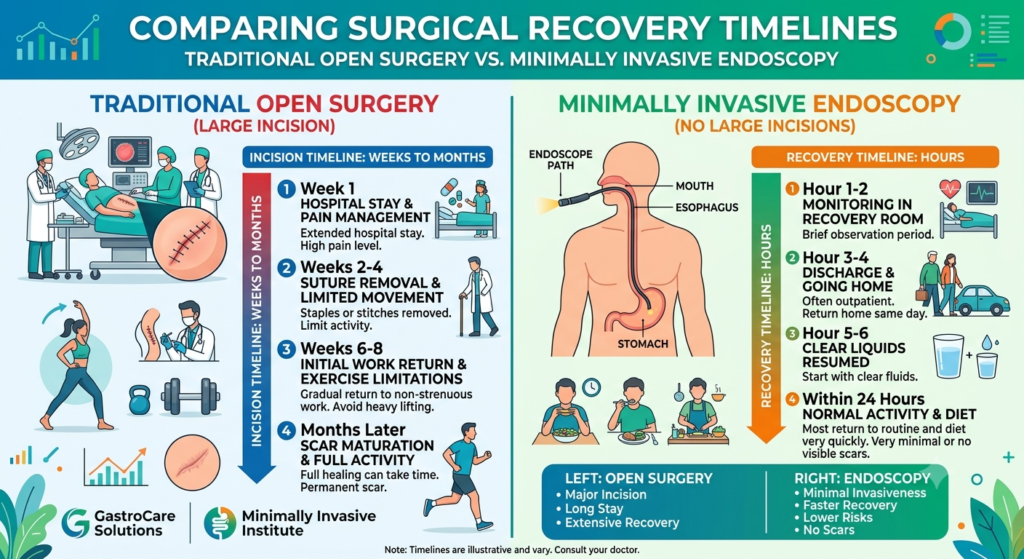
Endoscopy belongs to a broader category of minimally invasive procedures that have become standard practice across veterinary medicine, a shift documented by teaching hospitals such as Iowa State’s Lloyd Veterinary Medical Center, which notes that these techniques now extend well beyond the digestive tract into airway, urinary, and joint procedures as well.
Endoscopy for Dogs vs. Endoscopy for Cats: What to Expect
| Aspect | Endoscopy for Dogs | Endoscopy for Cats |
|---|---|---|
| Most common reason | Foreign body ingestion, chronic vomiting | Chronic vomiting, unexplained weight loss |
| Typical foreign objects found | Toys, bones, socks, string | String, hairties, plant material |
| Anesthesia approach | Standard general anesthesia with monitoring | Feline-specific anesthesia protocols |
| Recovery time | Same day to next morning | Same day to next morning |
| Follow-up needs | Recheck exam, diet transition if biopsy taken | Recheck exam, diet transition if biopsy taken |
Foreign Body Removal: When Endoscopy Becomes an Emergency Solution
A pet that has swallowed something it should not have is one of the more common reasons endoscopy gets scheduled urgently. According to the American College of Veterinary Surgeons, objects lodged in the stomach can sometimes be retrieved with an endoscope, while items that have already moved further into the intestine typically require surgical removal instead. That distinction is exactly why timing matters. If you know or suspect your pet swallowed something and they are showing signs of distress such as repeated vomiting, lethargy, or a painful abdomen, that situation calls for urgent evaluation rather than a wait-and-see approach. Our emergency pet care guide walks through what symptoms warrant an immediate visit.
Real Patient Case Study: Milo’s Story
Milo, a two-year-old Labrador mix, was brought in after his owner noticed him vomiting repeatedly and refusing food for two days. X-rays taken through our pet surgery diagnostics suggested a foreign object lodged in his stomach, consistent with a piece of a chewed-up rubber toy his owner had noticed was missing pieces. Because the object was still in the stomach and had not yet moved into the intestine, our veterinary team was able to retrieve it endoscopically rather than performing an open gastrotomy. Milo went home the same evening and was back to his normal energy and appetite within 24 hours, a recovery timeline that would have looked very different with traditional surgery.
Toronto Pet Endoscopy: Why On-Site Diagnostics Matter
Pet owners across the Toronto pet endoscopy landscape often assume this kind of advanced diagnostic tool is only available at referral specialty hospitals. Having on-site pet endoscopy in Mississauga means your pet’s entire diagnostic and treatment journey stays under one roof, with the same veterinary team managing the case from the initial exam through recovery, rather than adding the stress and delay of a separate referral visit. Our clinic’s investment in modern imaging and monitoring equipment is part of a broader shift in how general practice veterinary medicine operates, something our overview of advanced veterinary technology in Mississauga clinics covers in more depth.
Practical Tips for Pet Owners Before an Endoscopy Appointment
- Follow the fasting instructions exactly. Food in the stomach can prevent a clear view and delay the procedure.
- Bring a list of anything your pet may have swallowed. Even a rough guess helps guide the exam.
- Disclose current medications and supplements. Some can affect anesthesia safety and need adjustment beforehand.
- Plan for a quiet evening at home. Pets are typically groggy for several hours after anesthesia wears off.
- Watch for the follow-up call. If a biopsy was taken, results and next steps usually follow within several days.
- Pet-proof chew toys and small objects going forward. Recurrent foreign body ingestion is common in pets who chew compulsively.
Frequently Asked Questions
-
What is veterinary endoscopy used for?
Veterinary endoscopy is used to examine the esophagus, stomach, intestines, colon, or airway using a small camera-equipped scope, without the need for a large surgical incision. It helps diagnose the cause of chronic vomiting, diarrhea, or coughing, and can also retrieve certain swallowed foreign objects and collect biopsy samples for further testing.
-
Is veterinary endoscopy safe for dogs and cats?
Yes, endoscopy is considered a low-risk procedure when performed under proper anesthesia monitoring. As with any anesthetic procedure, pre-anesthetic bloodwork is used to confirm your pet is a good candidate, and continuous monitoring of heart rate, oxygen levels, and blood pressure continues throughout to keep the procedure as safe as possible.
-
How long does a vet endoscope procedure take?
Most endoscopy procedures take between thirty minutes and an hour, depending on what is being examined or retrieved. The anesthesia and recovery time adds additional hours to the total appointment, but most pets are ready to go home the same day, often groggy in the evening and back to normal energy by the next morning.
-
Can endoscopy remove a foreign object my pet swallowed?
In many cases, yes, if the object is still located in the stomach or upper digestive tract. Objects that have already moved further into the intestine typically cannot be reached with an endoscope and usually require surgical removal instead. This is why prompt evaluation after a known or suspected ingestion improves the odds of a minimally invasive retrieval.
-
How is endoscopy different from traditional surgery?
Endoscopy uses a scope passed through a natural opening rather than a surgical incision, which means less tissue trauma, lower infection risk, and a dramatically shorter recovery period. Traditional surgery is still necessary for objects that cannot be reached with a scope or for conditions requiring direct access to organs beyond what an endoscope can accomplish.
-
What does recovery look like after a pet endoscopy?
Most pets are groggy for the remainder of the day following anesthesia but are back to normal eating and activity by the next morning. Because there is no large incision, there are typically no stitches to manage or activity restrictions beyond a quiet evening at home, unlike the multi-week recovery period that follows open abdominal surgery.
-
How do I find pet endoscopy near me in Mississauga?
Look for a veterinary clinic with in-house endoscopy equipment, experienced veterinarians, and on-site anesthesia monitoring, rather than one that would need to refer your pet elsewhere for this kind of diagnostic work. Dixie Animal Hospital offers on-site pet endoscopy in Mississauga, keeping diagnosis, treatment, and follow-up care within the same clinic and veterinary team from the first exam through recovery.
-
What symptoms mean my pet needs foreign body removal urgently?
Repeated vomiting, refusal to eat, lethargy, a painful or bloated abdomen, or visible distress after a known ingestion are all signs that warrant urgent evaluation rather than waiting. Foreign objects can cause obstruction or, in more serious cases, perforate the digestive tract, so prompt assessment gives your veterinarian the best chance at a minimally invasive solution.
Sometimes the smallest camera in the room makes the biggest difference in your pet’s recovery.