
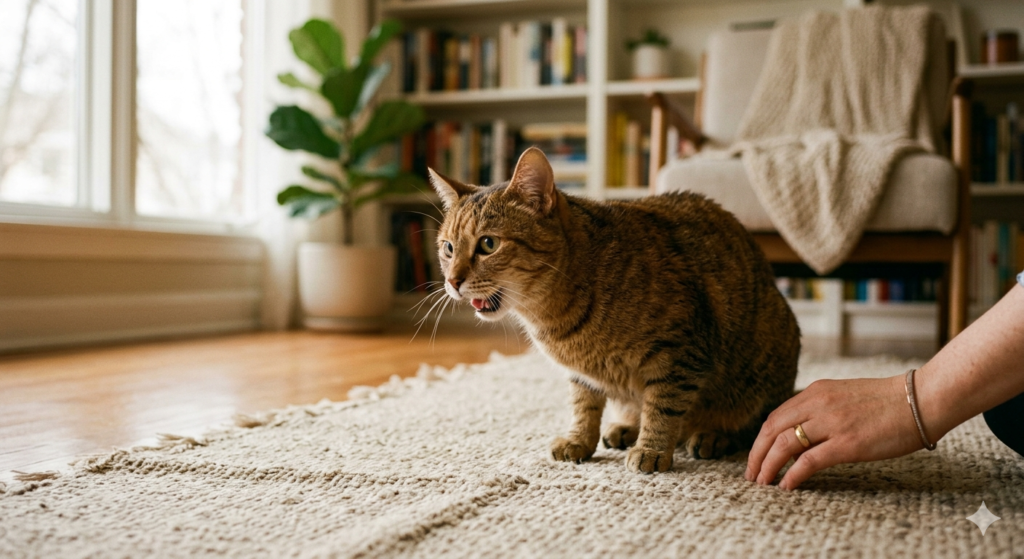
It usually happens late at night or early in the morning. You hear a strange, rhythmic hacking sound from somewhere across the room. Your cat is hunched low to the ground, neck stretched forward, body tensing with each spasm. Is it a hairball? Is she choking? Is something seriously wrong?
If you have ever searched “why is my cat coughing and gagging,” you are far from alone. This is one of the most common concerns cat owners bring to veterinary clinics, and for good reason. While occasional coughing can be perfectly harmless, persistent or severe episodes sometimes point to conditions that need professional attention. At Dixie Animal Hospital, we evaluate coughing cats regularly, and the range of causes we see goes well beyond the standard hairball.
This guide walks you through the most common reasons behind cat coughing and gagging, explains how to tell a harmless episode from a dangerous one, and outlines exactly when it is time to bring your cat in for an examination.
Common Causes of Cat Coughing and Gagging
Not all coughs mean the same thing. The sound, frequency, timing, and whether anything comes up afterward all provide clues about what is happening inside your cat’s body. Here are the conditions veterinarians encounter most often.
Hairballs vs. True Respiratory Cough
This is the distinction that trips up most cat owners. Hairballs (trichobezoars) form when cats ingest loose fur during grooming. The fur accumulates in the stomach, and when it cannot pass through the intestines, the cat retches it back up. The episode looks alarming, but it typically ends with a visible clump of compacted fur on your floor.
A true respiratory cough is different. It originates in the lungs and airways rather than the stomach. The cat may hunch down, extend her neck, and produce dry, wheezing sounds without bringing anything up. If your cat keeps coughing and gagging but never produces a hairball, that is the critical clue. Persistent dry coughing with no hairball output is not a grooming issue. It is a respiratory symptom that warrants investigation.
The posture can look nearly identical in both cases, which is why many owners assume every coughing episode is just another hairball. Recording a short video on your phone during an episode is one of the most helpful things you can do before a vet visit. That 15-second clip gives your veterinarian far more diagnostic information than a verbal description alone.
Feline Asthma and Chronic Bronchitis
Feline asthma is the most commonly diagnosed respiratory disorder in cats. According to the Cornell Feline Health Center, an estimated one to five percent of cats suffer from asthma, which translates to roughly 800,000 or more cats in North America. The condition develops when a cat’s immune system overreacts to airborne allergens like dust, pollen, cigarette smoke, or scented litter, causing inflammation and constriction of the airways.
During an asthma episode, cats assume a characteristic posture. They crouch low with their body pressed to the ground, extend the head and neck forward, and cough or wheeze repeatedly. Some episodes last just a few seconds. Others can escalate into full respiratory distress with open-mouth breathing, which is a veterinary emergency.
The tricky part about feline asthma is that symptoms are often intermittent. A cat might cough a few times per week for months, then have a sudden acute attack that leaves her gasping. Chronic bronchitis follows a similar pattern but involves ongoing inflammation of the bronchial tubes without the acute allergic component.
Both conditions are manageable with proper treatment, but accurate diagnosis matters because the medications differ depending on the underlying cause.
Upper Respiratory Infections
Upper respiratory infections (URIs) are extremely common in cats, particularly those adopted from shelters, multi-cat households, or outdoor environments. The two most frequent culprits are feline herpesvirus and feline calicivirus. These infections cause sneezing, nasal congestion, watery eyes, and sometimes coughing and gagging as post-nasal drip irritates the throat.
Most URIs resolve within one to three weeks with supportive care, but secondary bacterial infections can develop if the cat’s immune system is compromised. Kittens, senior cats, and cats with conditions like FIV or FeLV are at higher risk for complications. Keeping your cat’s vaccinations and parasite prevention current significantly reduces the risk of viral respiratory disease.
Heartworm-Associated Respiratory Disease
Most people associate heartworm with dogs, but cats are susceptible too, and the disease presents very differently in felines. According to the American Heartworm Society, cats are atypical hosts for heartworm, and most worms do not survive to the adult stage. However, even immature worms cause significant lung damage through a condition called heartworm-associated respiratory disease (HARD).
HARD triggers coughing, wheezing, and labored breathing that closely mimics feline asthma. The U.S. Food and Drug Administration notes that distinguishing HARD from asthma or bronchitis can be difficult, which is why diagnostic testing matters. Unlike dogs, cats have no approved treatment for active heartworm infection. Prevention is the only reliable protection, and fewer than five percent of cat-owning households use heartworm preventives regularly.
Foreign Bodies and Airway Obstruction
Cats are curious by nature, and they occasionally inhale small objects that partially obstruct or irritate the airway. Grass blades are one of the most common culprits, especially in cats with outdoor access. String, thread, small toy pieces, and even insects can get caught in the pharynx or trachea. A cat gagging and coughing after sudden onset, without any prior history of respiratory symptoms, should raise suspicion for a foreign body. If the object does not dislodge on its own, veterinary intervention is required. Endoscopy allows the veterinary team to visualize and retrieve foreign material from the airway without the need for invasive surgery in many cases.
Warning Signs That Require Immediate Veterinary Attention
Not every cough is an emergency, but certain symptoms signal that something serious is happening and your cat needs help right now. The Cornell Feline Health Center’s dyspnea resource identifies the three most common causes of respiratory distress in cats as asthma, congestive heart failure, and pleural effusion (fluid accumulation around the lungs).
Seek emergency veterinary care immediately if your cat is showing any of these signs:
- Open-mouth breathing or panting – Cats are obligate nose breathers. If your cat is breathing through her mouth, she is struggling to get enough oxygen.
- Blue or purple gums and tongue – This indicates cyanosis, a dangerous drop in blood oxygen levels.
- Labored breathing with visible abdominal effort – The belly should not be pumping visibly with each breath.
- Collapse or extreme lethargy after a coughing episode – This can indicate heart disease, severe asthma, or internal bleeding.
- Sudden onset of severe gagging with drooling – This pattern suggests a possible foreign body lodged in the throat or esophagus.
- Coughing with bloody discharge – Blood in mucus or saliva points to infection, trauma, or a mass in the respiratory tract.
When in doubt, err on the side of caution. A cat that is struggling to breathe can deteriorate rapidly.
How Veterinarians Diagnose a Coughing Cat
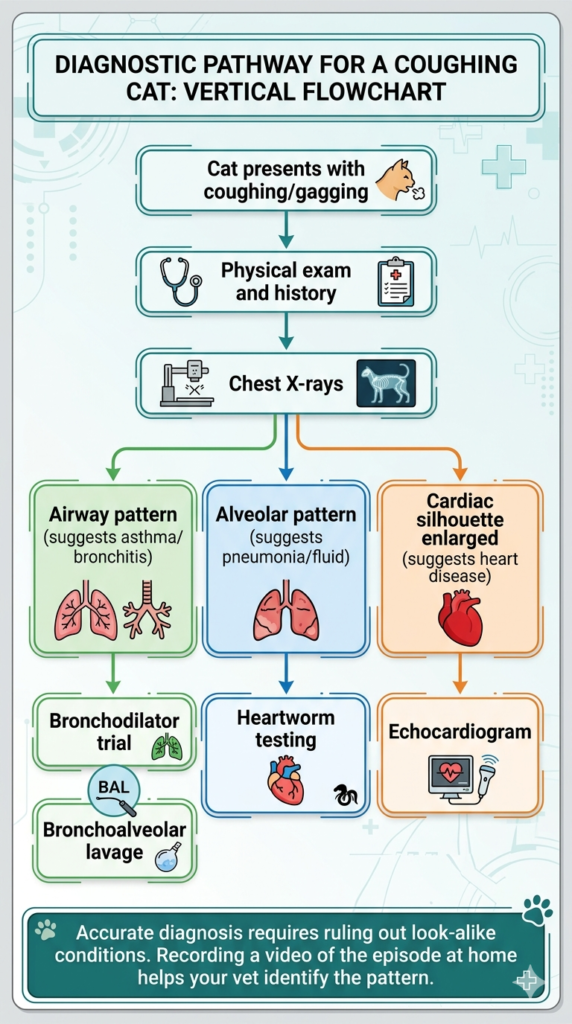
When you bring a coughing cat to the clinic, the diagnostic process follows a structured approach. It starts with a thorough physical examination, including listening to the lungs and heart with a stethoscope to identify crackles, wheezes, or murmurs.
From there, the veterinarian typically recommends chest X-rays as the first-line diagnostic tool. Radiographs reveal patterns consistent with asthma (characteristic “doughnut” shapes in the bronchi), pneumonia, fluid around the lungs, masses, or heart enlargement. For clinics with in-house diagnostics, results are available within minutes rather than days, which allows treatment to begin immediately.
Additional tests may include bloodwork to check for infection or heartworm antibodies, a fecal examination to rule out lungworm parasites, and in some cases, bronchoalveolar lavage (a procedure that collects fluid from the airways for microscopic analysis). The goal is exclusionary. Since no single test definitively confirms asthma, for example, the veterinarian rules out other causes to arrive at the correct diagnosis.
Coughing vs. Gagging vs. Vomiting in Cats
These three responses look confusingly similar in cats, but they originate from different body systems and point to different conditions. Understanding the distinction helps both you and your veterinarian narrow down the cause faster.
| Feature | Coughing | Gagging | Vomiting |
|---|---|---|---|
| Origin | Lungs and lower airways | Throat and upper airway | Stomach and upper digestive tract |
| Posture | Crouched, neck extended, body tense | Neck extended, mouth open, retching sounds | Abdominal contractions, heaving motion |
| Sound | Dry hacking, wheezing, or raspy | Retching, choking, or gulping sounds | Retching followed by expulsion of stomach contents |
| What comes up | Usually nothing, sometimes mucus | Nothing, or a small amount of saliva/foam | Food, bile, liquid, or hairball |
| Common causes | Asthma, bronchitis, heartworm, pneumonia | Foreign body, post-nasal drip, throat irritation | Dietary issues, toxins, GI disease, hairballs |
| When to worry | Recurring episodes without hairball production | Persistent gagging with drooling or distress | Vomiting more than twice in 24 hours |
A coughing cat that never produces anything is more likely dealing with a lower airway problem. A gagging cat that produces a hairball is dealing with a GI issue. When the two overlap and your cat is coughing and gagging simultaneously, it usually points to either airway irritation triggering a gag reflex, or post-nasal drip from an upper respiratory infection stimulating both responses.
Case Study: A Persistent Cough That Was Not a Hairball
A four-year-old indoor domestic shorthair named Pepper was brought to the clinic after her owner noticed intermittent coughing episodes over a three-week period. The owner initially assumed hairballs were the cause, since Pepper was a fastidious groomer. But no hairball ever appeared after the episodes.
During the physical examination, the veterinarian detected mild wheezing in both lung fields. Chest radiographs showed a classic bronchial pattern with thickened airway walls, a hallmark finding in feline asthma. Bloodwork returned normal, and heartworm testing was negative.
Pepper was started on a short course of oral corticosteroids to reduce airway inflammation, followed by a transition to an inhaled steroid delivered through a cat-specific spacer device. Within two weeks, the coughing episodes dropped from multiple times per day to once or twice per week. The owner was also advised to switch from scented clay litter to a low-dust, unscented alternative and to avoid using aerosol sprays in the home.
“I felt terrible that I had been dismissing it as hairballs for weeks,” the owner shared at a follow-up appointment. “She was clearly uncomfortable, and once we started treatment the difference was obvious.”
Pepper’s case is a textbook example of why recurring cat coughing and gagging should never be written off as normal without a veterinary assessment. A simple X-ray and a 10-minute exam changed her quality of life entirely. A deeper look at how your neighbourhood pet clinic approaches diagnostics and treatment can help set expectations before your visit.
Reducing Coughing Triggers at Home
If your cat has been diagnosed with asthma or chronic bronchitis, environmental management becomes a critical part of treatment. Even cats without a formal diagnosis benefit from cleaner air.
- Switch to low-dust, unscented litter – Clay litters generate significant dust that irritates feline airways. Paper, crystal, or pine alternatives produce far less particulate matter.
- Eliminate aerosol products – Hair spray, air fresheners, and cleaning sprays release fine particles that cats inhale at close range. Switch to unscented, non-aerosol alternatives.
- Control household dust – Vacuum with a HEPA-filter machine regularly, wash bedding weekly, and keep air vents clean.
- Avoid smoking indoors – Secondhand smoke is a documented trigger for feline asthma and increases the risk of lymphoma in cats.
- Manage humidity – Very dry air irritates airways. A humidifier set between 40 and 50 percent relative humidity can reduce irritation during Canadian winters.
- Schedule regular checkups – An annual wellness exam allows your veterinarian to catch subtle changes in lung sounds before symptoms escalate.
These adjustments will not cure asthma, but they reduce the frequency and severity of episodes and allow medications to work more effectively.
Frequently Asked Questions About Cat Coughing and Gagging
-
When should I take my cat to the vet for coughing?
If your cat keeps coughing and gagging more than once or twice per week, or if episodes last longer than a few seconds each time, a veterinary evaluation is warranted. Coughing that persists for more than 48 hours without producing a hairball is not normal grooming behavior. Open-mouth breathing, blue-tinged gums, or collapse after a coughing fit are emergencies that require immediate attention regardless of frequency or duration.
-
Is it normal for cats to cough like they have a hairball but nothing comes up?
Occasional dry retching is not uncommon, but repeated episodes of coughing or gagging without any hairball production are a red flag. This pattern is one of the most common presentations of feline asthma, where inflamed airways trigger the cough reflex without any stomach involvement. Only a veterinary examination with chest X-rays can confirm whether asthma, bronchitis, or another respiratory condition is responsible for the symptoms.
-
Can indoor cats get respiratory infections that cause coughing?
Yes. Indoor cats can develop upper respiratory infections through contact with contaminated clothing, shoes, or other pets who carry viral particles. Feline herpesvirus, for example, remains dormant in many cats and can reactivate during periods of stress. Keeping your cat current on core vaccinations significantly reduces the severity of respiratory infections even if exposure occurs through indirect contact.
-
How is feline asthma treated?
Feline asthma is managed with anti-inflammatory medications, most commonly corticosteroids, delivered either orally or through a metered-dose inhaler with a feline spacer device. Bronchodilators may be added for cats experiencing acute airway constriction. Environmental modifications to reduce allergen exposure are equally important. Asthma is a chronic condition with no cure, but most cats achieve excellent symptom control and maintain a good quality of life with consistent treatment and monitoring.
-
Can heartworm cause coughing in cats?
Yes. Heartworm-associated respiratory disease (HARD) causes coughing, wheezing, and breathing difficulty in cats that closely mimics asthma. Even immature heartworms that never reach adulthood trigger significant lung inflammation. Because there is no approved heartworm treatment for cats, prevention with monthly parasite control is the only reliable strategy. Ask your veterinarian about adding heartworm prevention to your cat’s routine health plan.
-
Should I record my cat’s coughing episodes before a vet visit?
Absolutely. A short video captured during a coughing or gagging episode is one of the most valuable tools you can bring to your appointment. Cats rarely perform their symptoms on command in a clinical setting. A video shows the veterinarian the exact posture, sound, and duration of the episode, which helps distinguish coughing from gagging or vomiting and guides the diagnostic workup more effectively.
A cough that keeps coming back is your cat asking for help in the only way she knows how — and the sooner you listen, the sooner she breathes easier.