

Heartworm prevention in Mississauga starts long before a dog shows a single symptom, and that is exactly what makes this parasite so dangerous. Spread by mosquitoes, heartworms settle in the heart and the large blood vessels of the lungs, where they can grow for months without a cough or a limp to give them away. By the time signs appear, the damage is often permanent. The good news is that heartworm disease is almost entirely preventable with a simple blood test and a consistent preventive. If you are looking for a vet near me who can build a sensible plan for your dog, this guide covers how heartworm spreads in southern Ontario, what the local data shows, how testing and preventives work, and what to do when a dose gets missed.
Why Heartworm Is Called a Silent Killer
Heartworm disease is caused by Dirofilaria immitis, a parasitic roundworm. Dogs are a natural host, which means the worms can mature, mate and produce offspring inside them. According to the U.S. Food and Drug Administration’s heartworm fact sheet, adult females can reach 10 to 12 inches long and survive five to seven years in a dog. A single dog may carry anywhere from one to 250 worms.
Long life, large size and almost no early symptoms. That combination is what earns heartworm its reputation. The worms crowd the heart and pulmonary arteries, inflame the vessel walls and force the heart to work harder with every beat, often for a year or more before an owner notices anything.
How a Mosquito Bite Becomes a Heart Problem
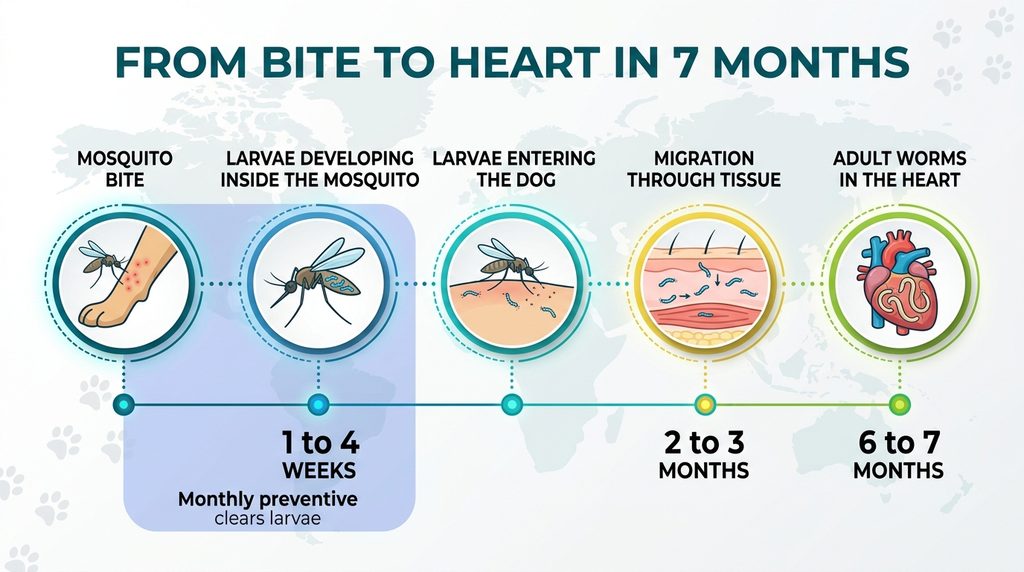
- The first bite: A mosquito feeds on an infected dog, coyote or fox and picks up microscopic larvae called microfilariae.
- Inside the mosquito: Over one to four weeks, depending on temperature, those larvae develop into the infective third stage.
- Transmission: When the mosquito bites your dog, larvae enter through the bite wound and moult again within a few days.
- Migration: For roughly two to three months, immature worms travel through tissue toward the heart.
- Maturity: About six to seven months after the bite, adult worms are producing their own microfilariae, and the cycle can continue.
Coyotes living in Mississauga’s ravines and creek corridors can act as a wildlife reservoir, which is one reason a dog does not need to travel to be exposed.
Warning Signs That Show Up Late
- A mild, persistent cough that never quite clears
- Tiring quickly on walks or losing interest in play
- Reduced appetite and weight loss
- Fast or laboured breathing while resting
- A swollen belly from fluid build-up in advanced cases
- Sudden collapse, pale gums or dark urine, which can signal a blockage known as caval syndrome
Caval syndrome is a true emergency. If your dog collapses or struggles to breathe, go straight to an emergency vet in Mississauga rather than waiting for a regular appointment.
Heartworm Risk in Ontario: What the Local Data Shows
Canada sees far less heartworm than the southern United States, but Ontario carries most of the national caseload. Figures compiled by the Canadian Parasitology Expert Panel give a clear picture of where the risk sits.
| Finding | What It Means for Mississauga Dogs |
|---|---|
| 431 of 564 canine cases in Canada’s 2010 national survey (76%) were diagnosed in Ontario | Ontario is the country’s heartworm hotspot |
| About 80% of Ontario cases occur south of Highways 401, 402 and 403 between Sarnia and Hamilton | Mississauga sits just east of that corridor, inside southern Ontario’s endemic zone |
| Average prevalence is about 0.5% of Ontario dogs, but 5% to 10% in some pockets among unprotected dogs | Risk is low on paper and concentrated in practice, mostly among dogs without prevention |
| Roughly 25% of 2010 cases involved imported or travelling dogs, yet half had never left their local area | Local transmission is real, not only a travel problem |
| Prevalence appears higher than in the 2002 survey | Warmer seasons may be extending mosquito activity |
Two groups deserve extra attention in the Greater Toronto Area. The first is dogs that cross the border for cottage trips or holidays in the U.S. The second is rescue dogs adopted from southern states, where heartworm is far more common. Both should be tested before any prevention plan begins.
Heartworm Prevention Near Me: How Testing and Prevention Work Together
Most people searching for heartworm prevention near me are picturing a monthly chewable. Real protection is a two-part routine: confirm your dog is negative, then keep it that way.
Step One: The Heartworm Test
A heartworm antigen test needs only a small blood sample. It is often run through in-house veterinary diagnostics during a routine visit and is commonly paired with screening for tick-borne infections such as Lyme disease. A positive screen should always be confirmed with a second sample, ideally using a different test method, and that confirmation may be sent to an outside veterinary diagnostic lab.
Timing matters. Antigen tests cannot detect an infection until roughly five to seven months after the infective bite, and they should not be run on puppies younger than six months. A spring test therefore picks up infections acquired the previous summer and fall.
Step Two: Choosing a Preventive
| Preventive Type | How It Is Given | Good Fit For | Points to Consider |
|---|---|---|---|
| Monthly chewable | By mouth, once a month | Dogs that take treats easily | Must be given on schedule; many also cover intestinal worms |
| Monthly topical | Applied to the skin between the shoulder blades | Dogs that refuse pills | Bathing and swimming timing may matter depending on the product |
| Long-acting injectable | Given in clinic by your veterinarian | Households that struggle with monthly reminders | Suitability depends on age and health |
| Combination product | Oral or topical | Dogs needing heartworm, flea, tick and worm coverage together | Matched to your dog’s lifestyle and exposure |
One detail surprises many owners: heartworm preventives work backwards. They kill larvae that entered the body during the previous month, before those larvae can mature. That is why protection continues for a month after mosquito activity ends.
Seasonal vs Year-Round Parasite Prevention for Dogs
Parasite prevention for dogs in Ontario usually follows one of two schedules. Each has a place, and the right fit depends on travel, lifestyle and which other parasites you want covered.
| Factor | Seasonal (June to November) | Year-Round |
|---|---|---|
| Heartworm coverage | Covers the typical local transmission window | Covers the window plus unexpected warm spells |
| Intestinal worms | Gaps through winter and spring | Continuous coverage with combination products |
| Ticks | Can miss early spring and late fall activity | Covers ticks active on mild winter days |
| Travel to the U.S. | Needs planning before each trip | Already protected |
| Habit building | Easy to forget the June restart | One routine all year |
| Guideline basis | Canadian expert panel schedule for Ontario | The American Heartworm Society’s Think 12 approach |
Mississauga’s Transmission Window
Drawing on 30 years of southern Ontario climate records, the CPEP heartworm guidance estimates that transmission runs, conservatively, from the first week of June to the second week of October. Monthly doses given from June 1 to November 1 cover that window with a margin. The same panel notes that climate change will probably lengthen the season, which is one reason many Mississauga clinics now lean toward year-round coverage.
What Happens If You Miss a Dose
- A day or two late: Give the dose as soon as you remember, then continue on the schedule your vet sets.
- More than two weeks late during mosquito season: Call your clinic before giving the next dose. Restarting and retesting about six months later is often advised.
- Several months skipped: A test before restarting is the safest route, since some products can cause reactions in dogs already carrying microfilariae.
Parasite Prevention Mississauga Owners Should Not Overlook
Heartworm is only one piece of the puzzle. A complete approach to parasite prevention in Mississauga also accounts for:
- Fleas: Common in multi-pet homes and apartment buildings, and a source of tapeworm infection.
- Ticks: Blacklegged ticks that can transmit Lyme disease are present in parts of the GTA. Our guide to flea and tick prevention in Mississauga covers them in detail.
- Roundworms and hookworms: Picked up from contaminated soil in parks and off-leash areas, and both can infect people.
- Whipworms: Their eggs survive in soil for years, which makes reinfection easy.
- Tapeworms: Usually caught by swallowing an infected flea while grooming.
Many combination products handle several of these at once, so one well-chosen preventive can replace a drawer full of separate treatments.
What Heartworm Treatment Involves and Why Prevention Is Easier
Treatment for Dogs
Treatment is possible, but it is long, demanding and carries real risk. The protocol recommended by the American Heartworm Society and supported by Canadian guidelines generally includes:
- Pre-treatment: A preventive to clear young larvae, plus a 28-day antibiotic course that weakens the adult worms.
- Adulticide injections: A series of three deep muscle injections spread over roughly a month.
- Strict rest: Weeks of exercise restriction, because dying worms can lodge in the blood vessels of the lungs.
- Follow-up testing: Months later, to confirm both adult worms and microfilariae are gone.
The so-called slow-kill method, which relies on a monthly preventive alone, is discouraged. It can take years, allows ongoing damage to the heart and lungs, and may help resistant parasites survive.
Cats Can Get Heartworm Too
Cats are less common hosts, but even one or two worms can trigger serious lung disease. Signs often resemble asthma: coughing, rapid breathing or vomiting, which overlaps with other causes of coughing and gagging in cats. No drug is approved to treat heartworm in cats, so prevention is the only reliable protection, even for indoor cats, since mosquitoes get inside easily.
Case Study: Catching Heartworm Before It Became Heart Disease
This is a composite example based on situations veterinary teams in the GTA commonly see. Names and details have been changed.
- Patient: Milo, a three-year-old Labrador mix
- Background: Adopted in spring from a rescue in Texas. His new family assumed his parasite care had been handled before transport.
- Finding: A routine antigen test at his first wellness visit came back positive. A second sample confirmed it, and chest X-rays showed mild changes in the lung arteries.
- Plan: Milo began the standard protocol of preventive, antibiotics and three adulticide injections, with strict leash-only rest for several weeks.
- Outcome: His follow-up tests came back negative, and he now stays on year-round prevention with an annual retest.
- Takeaway: Milo had no cough and plenty of energy. Without that first test, the worms would have kept growing quietly for years.
Pet Parasite Control Mississauga Checklist
Use this as a quick reference for pet parasite control in Mississauga households:
- Puppies: Prevention can begin early, before a test is needed. Families searching for a puppy vet near me can fold it into the first series of visits.
- Adult dogs: Test regularly and review exposure at pet wellness exams in Mississauga.
- Rescue and imported dogs: Test on arrival, then again six months later.
- Travelling dogs: Confirm coverage before any trip south of the border.
- Every dog: Bundle heartworm, flea, tick and intestinal worm protection under one preventive vet care in Mississauga plan.
- Reminders: Set a recurring phone alert for each dose date.
If your dog is due for a test, or you are unsure which product suits your household, schedule a visit with a dog vet near me and leave with a written plan for the year ahead.
Frequently Asked Questions About Heartworm Prevention in Mississauga
-
Do dogs in Mississauga really need heartworm prevention?
Yes. Ontario accounts for most of Canada’s canine heartworm cases, and Mississauga sits inside the southern Ontario zone where mosquitoes can transmit the parasite every summer. Overall prevalence is low, but unprotected dogs in some local pockets test positive far more often. Because treatment is long and risky while prevention is simple, most veterinarians recommend protecting every dog that spends time outdoors, even briefly in a backyard.
-
When should heartworm prevention start and stop in Mississauga?
Canadian expert guidance for Ontario supports monthly doses from June 1 to November 1, which covers the local transmission window with a safety margin. Preventives clear larvae picked up during the previous month, so the November dose is essential. Many clinics recommend year-round protection instead, especially for dogs that travel or need ongoing flea, tick and intestinal worm coverage. Your veterinarian will match the schedule to your dog’s real exposure.
-
How often should my dog be tested for heartworm?
Most dogs benefit from a yearly antigen test, ideally in spring before mosquito season begins. Annual testing catches infections from missed doses, vomited tablets or products that did not work as expected. Dogs that travel to the U.S., were adopted from southern regions or had gaps in prevention may need testing more often. A small blood sample is all it takes, and results are often available during the same visit.
-
Can my puppy start heartworm prevention right away?
Puppies can usually start heartworm prevention at around eight weeks of age, depending on the product. Testing is not needed before seven months because an infection would not yet be detectable. Starting early means your puppy is protected through its first mosquito season. Your veterinarian will choose a product suited to your puppy’s weight and adjust the dose as it grows, often alongside its vaccination schedule.
-
Is year-round parasite prevention for dogs better than seasonal?
Neither option is wrong, but year-round prevention suits many Mississauga dogs. It covers unexpected warm spells, keeps intestinal worms under control through winter and removes the risk of forgetting to restart in June. Seasonal prevention follows Canadian guidelines for heartworm and can work well for dogs with low exposure and owners who stay consistent. The right choice depends on lifestyle, travel and which parasites your dog meets.
-
What are the first signs of heartworm in dogs?
Early heartworm infection usually causes no visible signs, which is why testing matters so much. As worms mature, dogs may develop a mild, lingering cough, tire quickly on walks, eat less or lose weight. Advanced cases can bring laboured breathing, a swollen belly and sudden collapse. Any dog with breathing trouble or collapse needs immediate veterinary care, because severe heartworm disease can turn life-threatening within hours.
-
Can people catch heartworm from their dogs?
No, heartworm does not pass directly from dogs to people. The parasite needs a mosquito to develop into its infective stage. In very rare cases, an infected mosquito bites a person, but the larvae cannot mature into adult worms in humans and usually die. Treating and preventing heartworm in dogs reduces the number of infected animals in a community, which lowers the overall risk for everyone.
-
Where can I find heartworm prevention near me in Mississauga?
Dixie Animal Hospital provides heartworm testing, prescription preventives and complete parasite control for dogs and cats in Mississauga. A visit includes a physical exam, a blood test when needed and a prevention plan built around your pet’s lifestyle, travel and age. The team can also combine heartworm protection with flea, tick and intestinal worm coverage, so your dog stays protected with one simple routine all year.
A monthly dose takes seconds, while heartworm treatment takes months, so protect your dog’s heart before the next mosquito season arrives.